
Mold Under the Kitchen Sink: Slow Leaks in San Diego Homes
The cabinet under the kitchen sink is dark, closed and full of pipes. It is also one of the most common places to find mold in a home, because a slow drip can run for weeks before anyone notices. By the time you see spots on the cabinet floor or smell something musty, the wood may already be swollen and the wall behind it damp.
This guide covers how to find the leak, what you can clean yourself, when the job grows into remediation, and how California insurance and rental rules tend to treat it. It applies to bathroom vanities and laundry sinks too. The examples are for homes in San Diego, CA and nearby San Diego County towns.
The short version. Find and fix the leak first. Dry everything within 24–48 hours, as EPA advises. Small spots on hard surfaces can usually be cleaned. Swollen particleboard, a damp wall or soft flooring usually means removal and a closer look.
Why mold grows under sinks
Mold needs moisture and something to feed on. The sink cabinet offers both. Most cabinet floors are particleboard or plywood, and stored cardboard boxes, paper bags and sponges add more food. The door stays shut, so water that drips never dries.
Common leak points:
- Supply lines and shutoff valves, especially older braided or plastic lines.
- The P-trap and its slip nuts, which loosen over time.
- The seal where the faucet or sprayer meets the countertop.
- Dishwasher supply and drain connections.
- Garbage disposal seals and the drain flange.
- Water filters and reverse-osmosis units with small fittings.
- Splashing at the counter edge that runs down the back of the cabinet.
Age plays a part. The median home in the City of San Diego was built in 1979, and 52.4% of units were built before 1980 (ACS 2020–24 5-year). Many kitchens have been remodeled since, but plenty still have decades-old valves and drain lines behind the doors. San Diego's dry weather outside does nothing for a closed cabinet with a drip inside it.
How to check your sink cabinet
- Empty it. Take everything out and set aside anything wet or stained.
- Look with a flashlight. Check the cabinet floor, the back wall, the corners and the underside of the countertop for stains, spots, swelling or rust on fittings.
- Do the paper towel test. Dry each joint, then wrap or touch a dry paper towel to it. Run the faucet, the dishwasher and the disposal, and check again. A damp spot shows where the leak is.
- Press the cabinet floor. Soft, bulging or flaking particleboard has been wet for a while.
- Check the wall and floor nearby. Look at the baseboard, the toe kick and the floor in front of the cabinet. Warped flooring or a musty smell at floor level suggests water has spread.
If you find a leak at a fitting, shut off the valve and call a plumber or tighten what you safely can. Mold cleanup is wasted effort while the leak keeps running.
What you can clean yourself
When the leak is fixed and the mold is a few spots on a hard surface, cleaning is usually enough. EPA's homeowner guidance is commonly summarized as treating patches smaller than about 10 square feet, roughly 3 feet by 3 feet, as a job most people can handle themselves once the water problem is fixed. Check EPA's current mold pages before relying on that figure.
- Wear gloves and eye protection, and ventilate the kitchen.
- Scrub hard surfaces such as pipes, laminate and sealed wood with detergent and water, then dry them.
- Throw out wet cardboard, paper and sponges.
- Run a fan into the open cabinet until everything is fully dry.
- Replace a swollen or crumbling cabinet floor rather than trying to clean it. Particleboard does not recover.
EPA advises drying water-damaged areas and items within 24–48 hours to prevent mold growth. Leave the doors open for a day or two after any spill.
When it becomes a remediation job
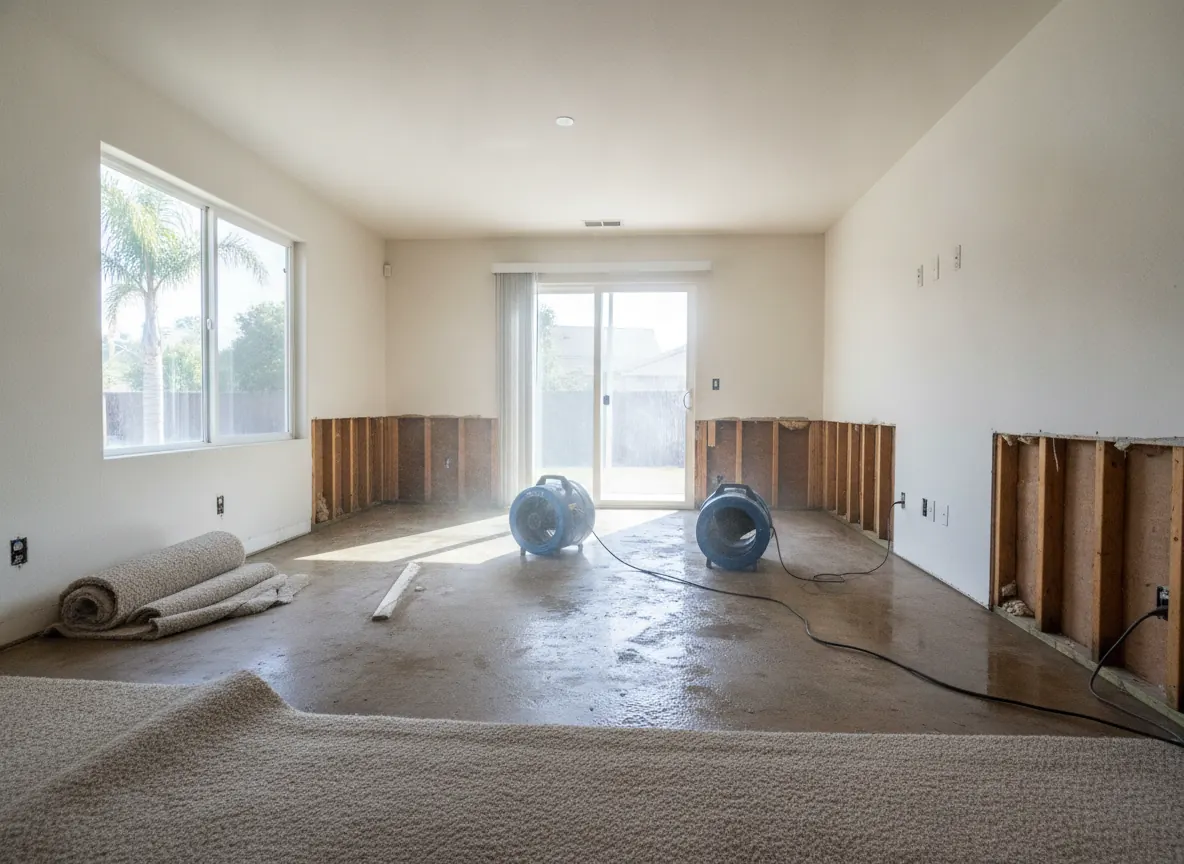
A slow leak can wick into the wall behind the cabinet and under the flooring. These signs usually mean the job is bigger than a wipe-down:
- Mold or staining on the drywall behind the cabinet back.
- A wall that reads damp on a moisture meter or feels soft.
- Cupped or lifting flooring in front of the sink, or a soft subfloor.
- A musty smell that stays after the cabinet is dry.
- Staining on the ceiling below, if the kitchen is upstairs.
The work usually means pulling the cabinet or its back, removing wet drywall and flooring, drying the cavity, and cleaning the framing before anything goes back. The water damage and mold page covers drying after a leak, and the mold removal page explains containment and clearance.
Permits and licenses come into play here. In the City of San Diego, drywall replacement tied to a plumbing repair is exempt from a building permit when the total area is 100 square feet or less (DSD Information Bulletin 203, July 2024). Larger drywall replacement usually goes through a No-Plan permit, and plumbing work can need its own trade permit. Historic homes are excluded from the exemptions. Outside the City, check with your city. Any job of $1,000 or more, or one that needs a permit, requires a CSLB-licensed contractor.
Older homes may have asbestos in flooring, mastic or drywall joint compound. Ask whether testing is needed before tear-out. In condo and apartment buildings with five or more units, San Diego County APCD Rule 1206 requires an asbestos survey and 10 working days' notice before renovation that disturbs 100 square feet or more.
Does insurance cover mold under the sink?
Often not, and the cause matters. The California Department of Insurance's Residential Insurance Guide (Jan 2026) lists mold among perils that are usually excluded. It lists sudden and accidental water damage as typically covered, and water damage from seepage or leaks as not covered. A supply line that bursts is a different story from a drip that ran for months.
Check your declarations page and policy wording, take dated photos, and call your insurer or CDI with questions. Our post on whether homeowners insurance covers mold goes deeper. Nobody can promise coverage before a claim is reviewed.
If you rent
Tell your landlord about the leak in writing and keep a copy. Under Civil Code 1941.7, a landlord's duty to repair a mold condition starts once the landlord has notice, and the landlord may enter to make repairs with proper notice. Retaliation for a good-faith complaint is restricted for 180 days under Civil Code 1942.5. See the rental and condo mold guide. Not legal advice.
Before you hire anyone
California does not license mold inspection or remediation as its own trade, so checking credentials is up to you. The CSLB classification list has no mold class. Ask each company for:
- A CSLB license number for any job of $1,000 or more, any job that needs a permit, or any job with a crew. Look it up at cslb.ca.gov.
- IICRC or ACAC certification for the people doing the work, which you can check on iicrc.org and acac.org.
- A current insurance certificate.
- A written scope and protocol: what gets removed, cleaned and dried, and how the work area is contained.
- A plan for the moisture source, whether the company fixes it or a plumber or roofer does.
- Independent clearance testing after the work, from someone other than the remediation company, if you want proof it is done.
- A written contract for any home improvement job over $500 (Business and Professions Code 7159).
Frequently asked questions
Is mold under the kitchen sink dangerous?
EPA says molds have the potential to cause health problems, and CDC notes some people get a stuffy nose, coughing or eye irritation. Fix the leak, dry the cabinet and remove the mold. Ask a doctor about any health concerns.
Can I just clean mold under my sink myself?
Often, if the leak is fixed and the mold is a few spots on hard surfaces. EPA guidance is commonly summarized as treating patches under about 10 square feet as a homeowner job. Replace swollen particleboard, and get quotes if the wall or floor is wet.
Will homeowners insurance pay for mold from a leaking sink?
It depends on the cause and your policy. The California Department of Insurance says mold is usually excluded, sudden and accidental water damage is typically covered, and seepage or leaks are not. Check your declarations page.
Who fixes mold under the sink in a rental?
Usually the landlord, once notified. Civil Code 1941.7 says the duty to repair a mold condition starts after the landlord has notice, so report it in writing and keep a copy. This is not legal advice.
San Diego Mold Experts is a free quote service, not a mold company. You describe the problem once, and independent mold inspection and remediation companies serving San Diego, CA and nearby San Diego County towns may reply with quotes. Companies may pay to receive requests or calls, and they reply on their own schedules. Request free quotes or call (619) 489-9035.